

Start with the right record
These examples explain document layout, not the legal position of any particular property. Names, addresses and identifying references have been redacted. The numbered reading notes refer to headings in the samples; they are not entries added to the registry records. Open each image or its PDF to read the small print.
| Property location | Ownership record | Map document |
|---|---|---|
| England and Wales | Title Register | Title Plan |
| Scotland | Title sheet | Title plan |
| Northern Ireland | Property folio | Registry map |
The supplied record may have more pages, schedules or different entries. A sample is not evidence about your home and is not a document offered for sale. For a buying decision, use the document comparison; for map options, use the property boundary guide.
1. Reading an England and Wales Title Register
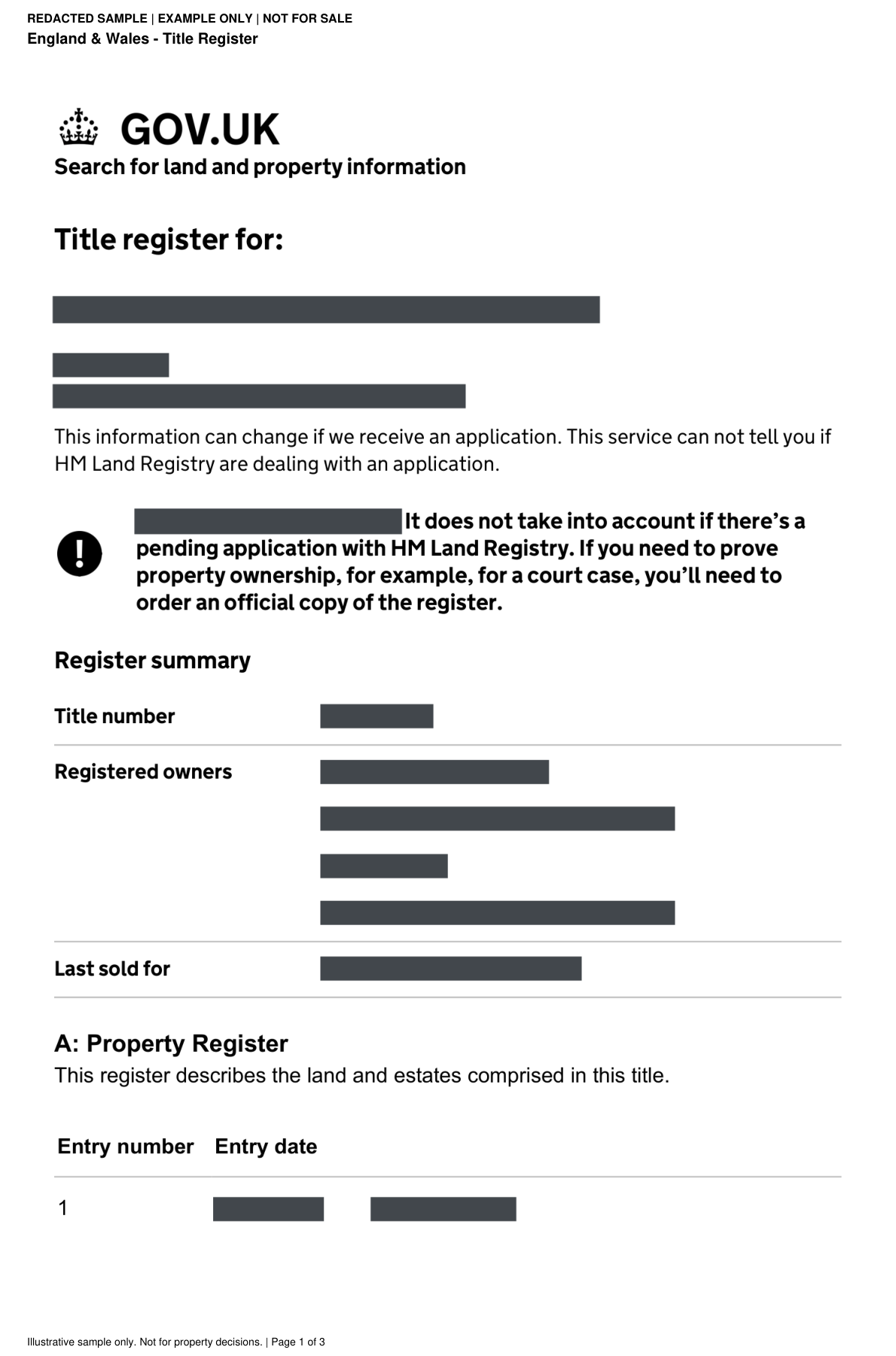
Redacted example, page 1. Open the complete three-page sample register (PDF). The original sample notices remain visible.
- Summary and title number: use the reference to pair this register with its plan. An address alone is not a reliable way to distinguish neighbouring or overlapping titles. The sample's identifying fields are intentionally hidden.
- A: Property Register: read the property description and tenure first. Note references to leases, rights or land described elsewhere before looking at the map.
- Date and time: record the date of the copy you are reading. Do not treat an older saved PDF as a live search result.
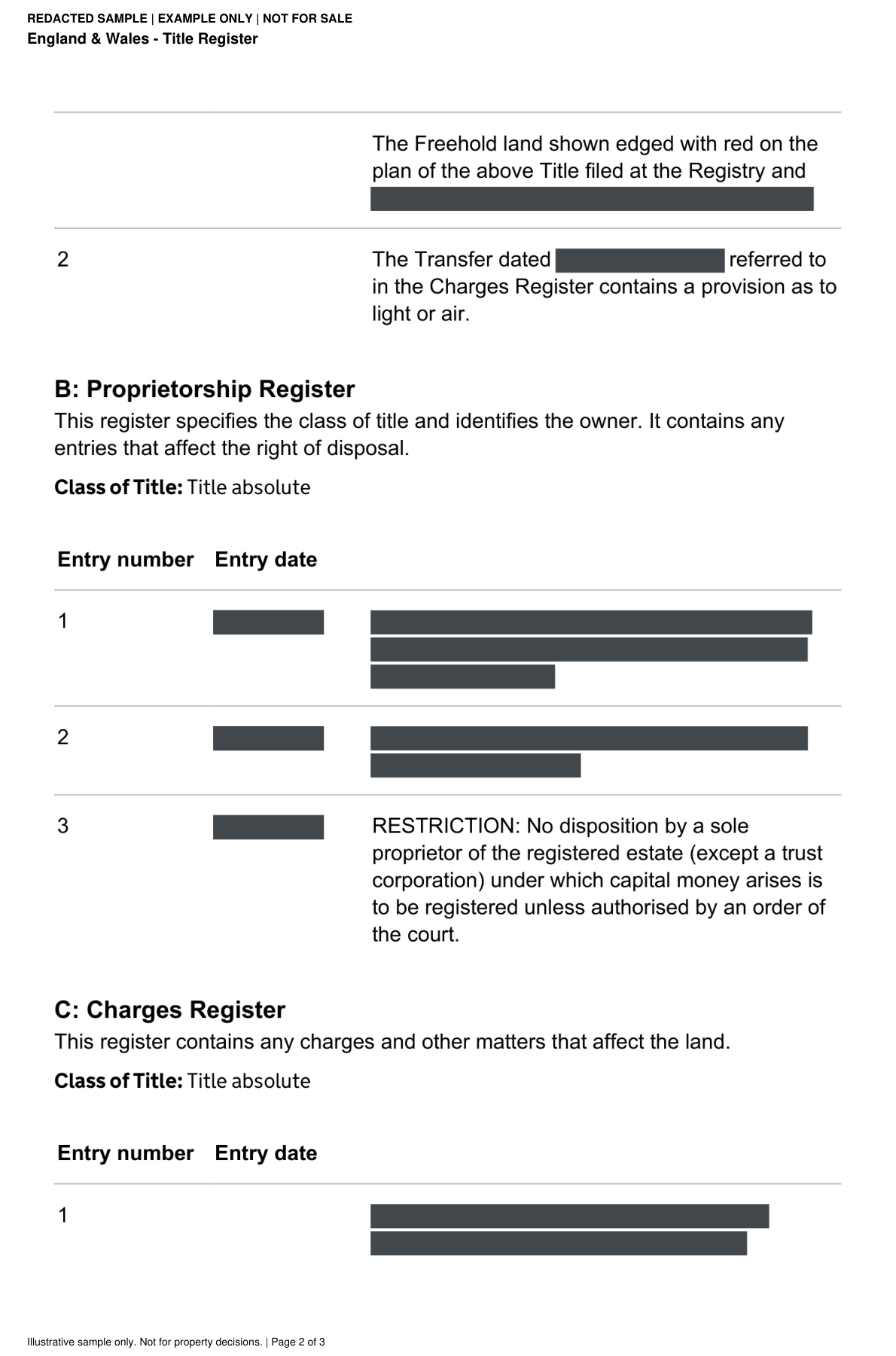
Redacted example, page 2. The ownership fields are hidden; the section headings show where to look in your own copy.
- B: Proprietorship Register: look for the registered owner, class of title and any restrictions. A registered owner's name is different from the name of an occupier or managing agent.
- C: Charges Register: read charges and other entries affecting the title, including references to separate documents. A reference is not the full text of the document it names.
- Continuation pages: finish the record, including schedules and notes. Do not stop at the summary or first mortgage entry. Take unclear entries to a solicitor rather than inferring their effect from this example.
Official source: https://www.gov.uk/government/publications/how-to-read-a-title-register-and-title-plan/how-to-read-a-title-register
For an England or Wales property, order a Title Register for your selected property, subject to availability. The example above is not a document for your property.
2. Reading a Title Plan alongside the register
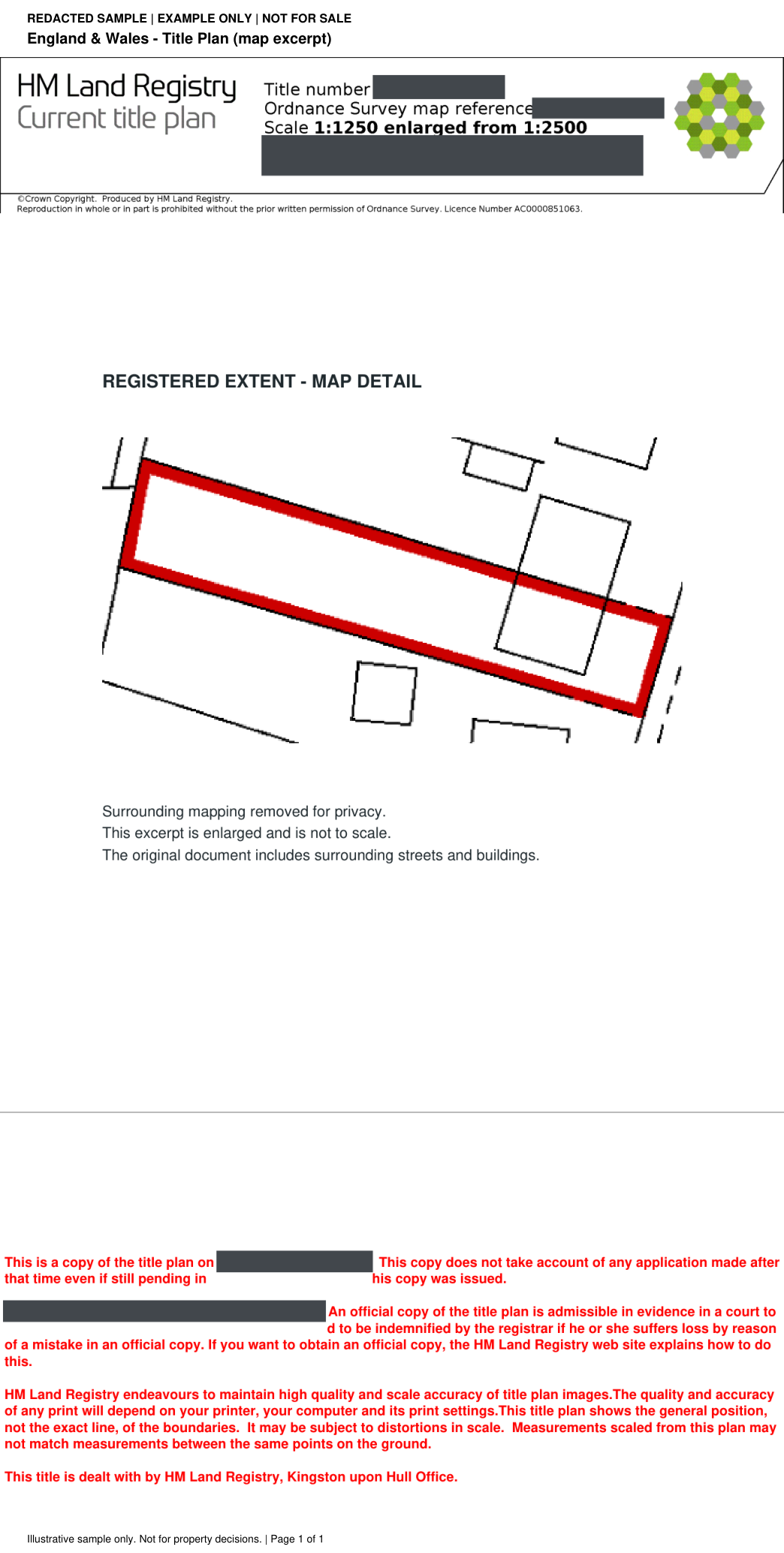
Redacted example. Open the sample Title Plan (PDF). Retain the map's copyright and scale information when referring to a copy.
- Match the reference: compare the title number with the register, not just the street name.
- Locate the land: use surrounding roads and buildings to orient yourself. Work from the whole sheet before enlarging one corner.
- Read the edging and register together: red edging normally indicates the general extent. Other colours or numbered areas need the register's explanation; they are not a universal key to fence ownership.
- Do not measure an exact fence line from the screen: the line thickness, map scale and general-boundaries basis limit what can be concluded. Zooming in does not add survey accuracy.
Official source: https://www.gov.uk/government/publications/how-to-read-a-title-register-and-title-plan/how-to-read-a-title-plan
For an England or Wales property, order a Title Plan for your selected property, subject to availability. The example above is not a document for your property.
3. Reading a Scottish title sheet
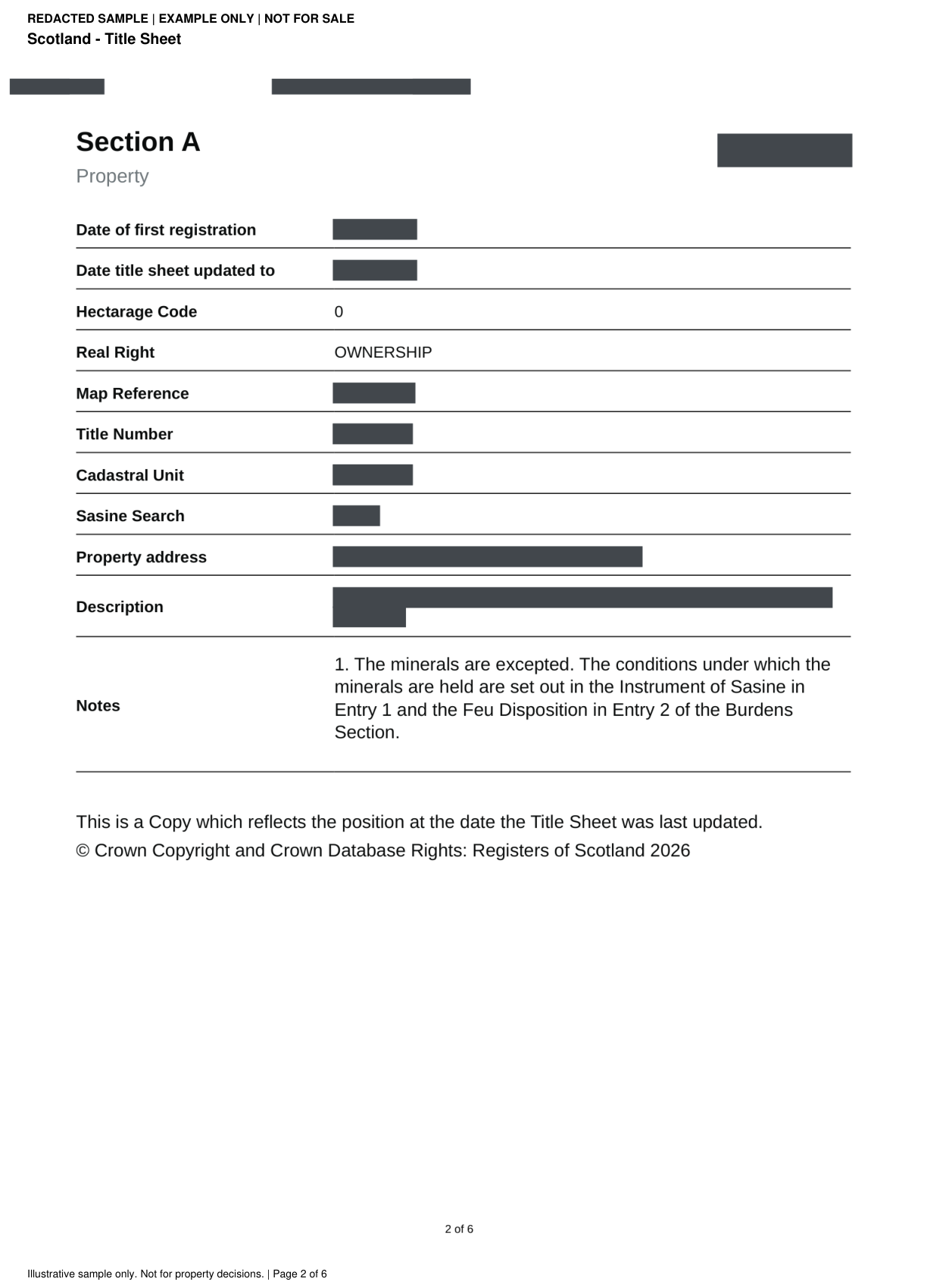
Redacted example, Section A. Open the complete sample title sheet (PDF) and sample Scottish title plan (PDF). These are Scottish records, not HM Land Registry documents.
In this example, start with Section A Property and the title reference. Then read the Proprietorship, Securities and Burdens sections in the complete PDF. Keep a separate note of an ownership entry, a mortgage entry and an obligation: they answer different questions. A mention of common ground or maintenance may need the rest of the title and referenced deeds to make sense.
If your result is a Sasine search sheet or an application record instead, do not expect it to follow this sample's layout. The Scotland guide explains those alternative records and their limitations.
Official source: https://www.ros.gov.uk/services/order-deeds/deed-types-and-granters/what-title-documents-can-tell-you
4. Reading a Northern Ireland folio and map
Open the redacted property folio (PDF) and redacted registry map (PDF).
Start with the folio reference, county and search date on the cover, then read the entries on the later pages. Match the map to the folio before comparing it with the property address. Note pending applications where shown. A blank-looking or heavily redacted sample page does not mean that a real property's record contains no rights or charges.
The Northern Ireland guide explains why a folio search and a Registry of Deeds enquiry are not interchangeable. These samples do not establish whether you need a certified copy for your particular purpose.
Official source: https://www.nidirect.gov.uk/articles/how-find-property-and-land-information
5. What a GPS Boundary Report adds
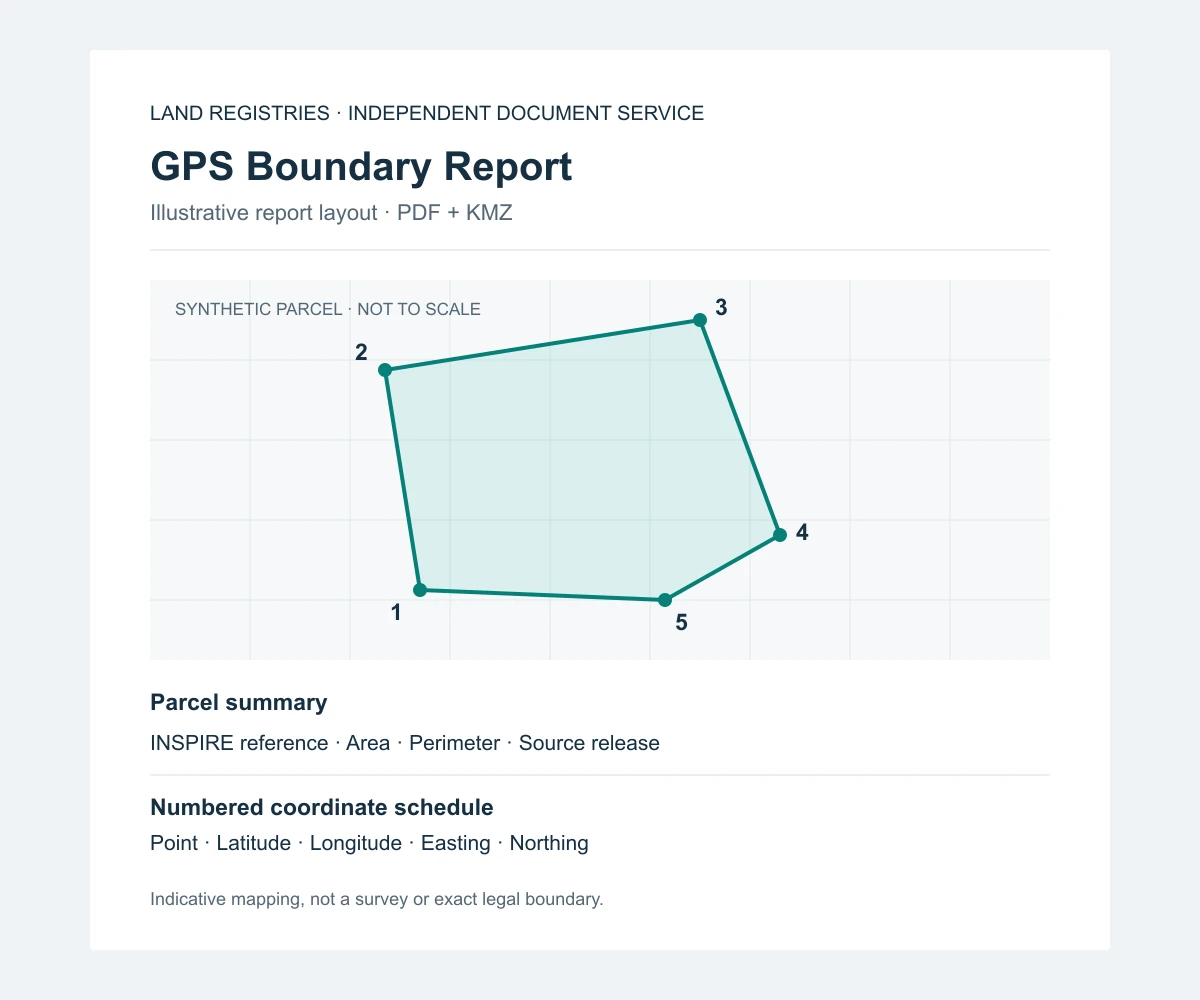
Illustration only: a synthetic parcel, not a customer's report or an extract from a surveyed property.
The PDF is the readable report: check its parcel reference, source information, mapped shape and coordinate table. The KMZ is the companion map file for a compatible viewer such as Google Earth. Open the file in the viewer, locate the parcel and compare its shape with the PDF; do not use a phone's location dot to set out a fence.
Coordinates describe the supplied mapping. More decimal places, a satellite background or a closer zoom do not make it an exact legal boundary. The report is prepared by Land Registries, not HM Land Registry, and is not a measured boundary survey. Current GPS products are for eligible properties in England only; availability is checked for the selected property. A mapped parcel is not proof that a Title Plan or every adjoining title is available.
A practical checklist before taking action
Consider a hypothetical house with a separately registered adjoining strip. The same street address could lead you to the house title while your question concerns the strip. Before ordering further documents or relying on a report:
- Write down the precise question: ownership, a right of way, maintenance, or the extent of a particular parcel.
- Check the region, title or folio reference, and date on every file.
- Compare the full register or folio with its matching plan, including separate areas and referenced documents.
- List any adjoining title that still needs investigation; do not assume one address equals one title.
- Mark what the documents do not answer. Take a genuine boundary dispute to a solicitor and, where appropriate, a qualified surveyor before moving fences or making legal claims.
LandRegistries.com is an independent document-ordering service, not a government registry or a source of legal advice. You can also use the official regional registries directly. For the difference between information copies and formal evidence, read digital and official-copy documents.